112) The Talos Principle (2014)


During the development of Serious Sam 4, the developers at Croteam began to experiment with the use of interactive objects as part of the game design. This led to the creation of some complicated puzzles that, while they didn't quite fit the action based design of Serious Sam, the team felt inspired by to build upon as a separate title. After about a year of development, with around 80% of the puzzles that would be used having been completed, the team brought in Tom Jubert and Jonas Kyratzes to link the puzzles together into a proper narrative. Drawing upon their previous work delving into matters of artificial intelligence, transhumanism, and the philosophical differences between body and soul, they quickly devised a narrative centered around an automaton being guided by a god-like being through a series of puzzles
With a basis built upon the principles of the fictional Greek philosopher Stranton of Stageira, who argued that the consciousness of Talos, a mechanical man created by the Gods, implies that humans are also machines, albeit biological in design, the game's narrative delves deep into what exactly it is that makes a person human. The narrative, presented primarily via text logs found on computer terminals, leans heavily into both philosophical and religious ideologies, often presenting ideas and questions rather than strictly answers.
We begin the game by awakening in a serene, idyllic environment. A disembodied voice calling itself Elohim instructs the player to explore the world that he has created for us, encouraging the player to solve puzzles to collect sigils in order to progress, but warns the player not to climb a large tower that stands at the center of these created worlds. It's made clear pretty quickly that the worlds we explore exist only as a virtual reality, and we encounter messages left by other AI with varying views on the artificial worlds and Elohim, ranging from casting doubt on his word to openly doubting him. At first, we only encounter these messages in the form of QR codes painted onto random walls.

Eventually, after interacting with various computer terminals in each world that hold various bits of lore and philosophy, the player interacts with a being that begins to question them on various topics. Initially taking the form of asking questions to evaluate the player, the mysterious entity begins to push against the player's worldview, debating the player on lofty subjects and attempting to poke holes in the player's rationale. They encourage the player to explore further, both physically and mentally, and push the player to question Elohim and his motivations. If Elohim is so wise and powerful, why would the tower exist if he forbids exploration of it? What is the point of the puzzles presented to us, and how many have come before us? If the player can be made to question anything of Elohim, does that not mean they should question everything?
If these questions and philosophies seem familiar, it's because, at their core, they echo the foundations and debates surrounding religion. The artificial worlds can be viewed as the Garden of Eden, while the tower and our interactions with the other AI mirrors the temptation and corruption of Adam and Eve. The game never really directly tells you what the "correct" answers are, either in puzzles or in the philosophical questions it raises, instead encouraging the player to explore and arrive at their own solutions. It's a beautiful, albeit a tad ham-fisted, way to introduce such philosophical quandaries in a manner that doesn't outright offend any particular religion.
Story aside, the game features well over 100 puzzles for the player to solve. New mechanics and pieces are added gradually, with players having to first unlock them. Each puzzle is clearly separated from the others, with barriers of light present in order to prevent the player from taking tools in or out of them individually. This is primarily to ensure the player doesn't lock themselves out of being able to complete any one puzzle, but also serves to limit the chance of players breaking the puzzles with outside elements. Most of the puzzles are pretty straightforward, with the difficulty and complexity increasing gradually. You'll find yourself having to get creative in how you combine your various tools, and the player is encouraged to think outside the box, especially when it comes to some of the hidden puzzles that do require elements from otherwise unconnected puzzles.
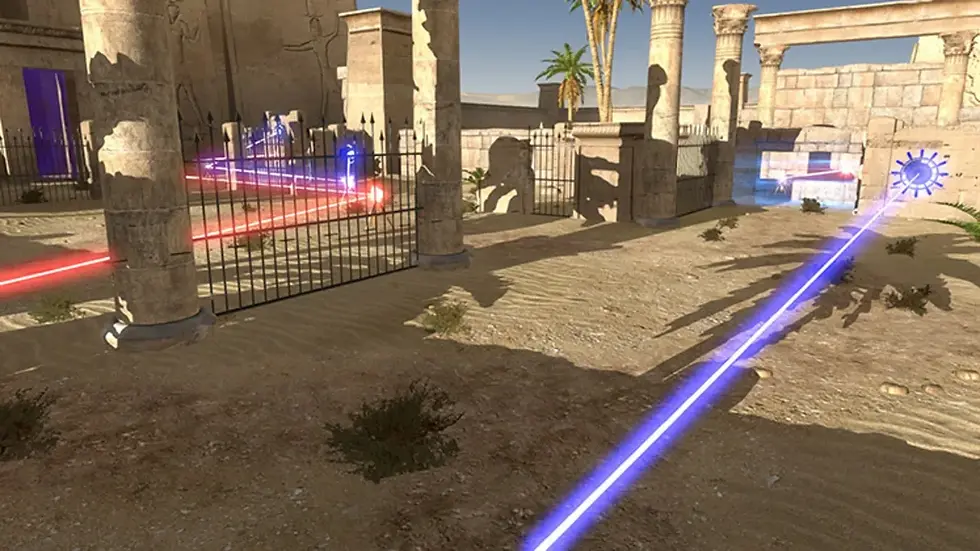
The Talos Principle is an excellently designed puzzle game, with puzzles that can be challenging while remaining completely fair. Sometimes, if you're stuck on a particular section, it's best to step away and tackle a different puzzle to help adjust your perception. The hardest puzzles are completely optional, as well they should be, and genuinely leave a sense of accomplishment upon completion. Outside of the purely mechanical aspects, the game makes excellent use of its premise in order to delve into philosophical and good natured religious debates. The game will never flat out tell you that your viewpoint is wrong, simply encouraging you to think critically and lightly pushing at the boundaries of belief. The game is intriguing and compelling, and I highly recommend it for anyone wanting to excercise their mind in a mostly serene environment.


Comments