72) 999: 9 Hours, 9 Persons, 9 Doors (2009)
- dpad200x
- Feb 6
- 4 min read

Updated: Feb 11
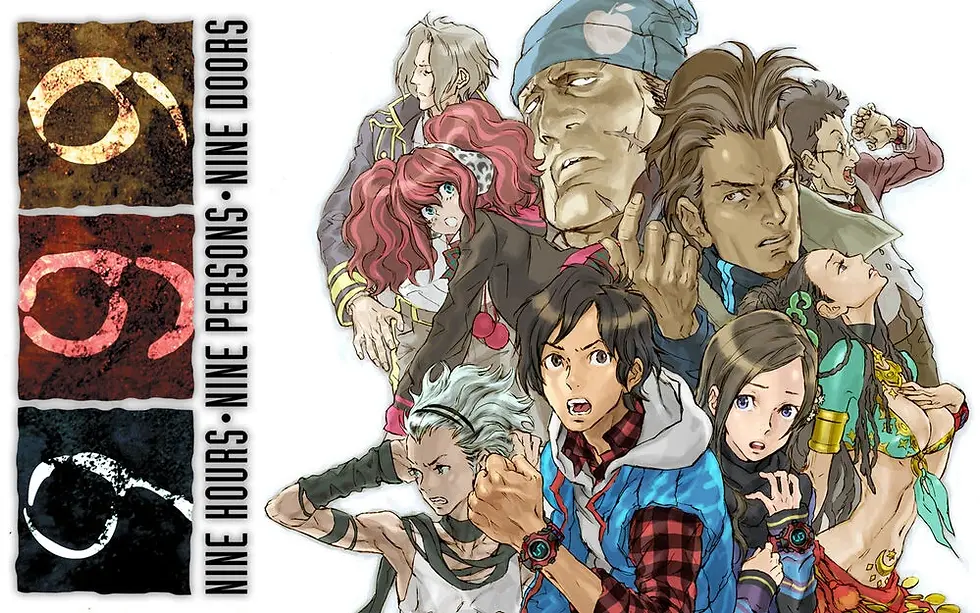
Beginning development in 2008, 999 was the first title for which Kotaro Uchikoshi would serve as director in addition to his duties as writer and designer. Bringing his love of browser based escape room games, and feeling they could benefit from a larger focus on storytelling, the game plays largely as a visual novel with puzzle elements added that serve to deepen the mystery surrounding the plot. Uchikoshi's writing style, which sees a larger emphasis on storylines over characters, begins with him coming up with the ending, then working backwards from there. After figuring out the plot and twists, he then attempts to create a balanced cast of characters in regards to gender, ages, and personalities. Using the Enneagram of Personality as a guide, the greater emphasis on the number nine begins to become clear.
The inspiration for the story ironically came from the question "where do mankind's inspirations come from?". Uchikoshi's research into this led him to the work of British author Rupert Sheldrake, whose theories on morphogenetic fields, which function similar to telepathy, became the backbone and primary theme of the game. The story heavily features different pseudosciences while sprinkling in just enough real world facts and trivia to give the narrative a unique cohesion that works surprisingly well. While obviously relying on the paranormal and being more than a little convoluted, the narrative manages to avoid some of the bigger pitfalls of such an approach by having the characters themselves actively question the things happening and never fully showing its hand.
Our story begins with our protagonist, Junpei, waking up in what appears to be a ship's cabin with a strange watch-like device on his wrist. With only vague memories of being abducted, we're quickly introduced to the puzzle aspect of the game as our cabin begins to flood with water. The only door out is locked with a strange device that requires the use of numbered keycards that are hidden in the room. While this does a great job of giving us a sense of urgency, it proved to be one of the harder puzzles in the game by simple virtue of needing to understand what the game is expecting.
After escaping, we're introduced to the rest of the eccentric cast, all with similar stories of abduction, waking up in a locked room, and having the devices on their wrists. Among them is Akane, a childhood friend that immediately refers to us affectionately as "Jumpy". It's here we're given a broader idea of what's going on, as a mysterious voice, identifying as "Zero", lays out how the rest of the game will play out, giving us the rules for how to escape the sinking ship. Needing a way to refer to one another but not wanting to reveal personal information, everyone chooses a code name based on the number on their bracelet. Everyone, that is, except for Junpei, who Akane blatantly identified right away, and the wearer of bracelet number nine. The mysterious ninth man, who seems incredibly jumpy, serves the role of showing how real the stakes are by quickly dying when he doesn't follow the rules.
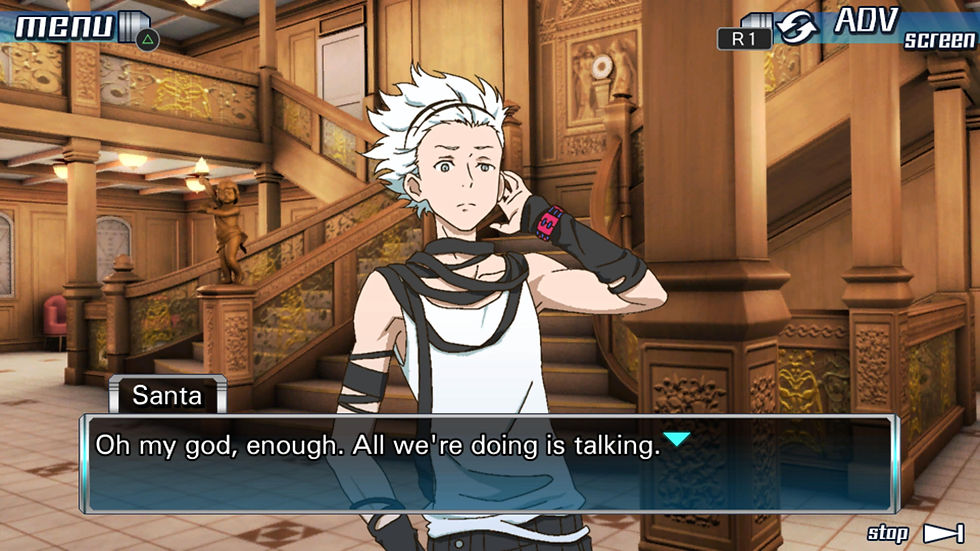
From here, we're presented with numerous branching paths, leading us to different puzzle rooms as we work to unravel the mystery of what's going on. There are numerous paths to take, and the game includes multiple endings, the majority of which are bad, involving the deaths of either us or everyone around us. Each puzzle is sprinkled with new information, either about the people around us or the overall plot, and it's impossible to understand everything in one go. Normally, I'd hate this approach and probably wouldn't bother seeing every ending, but a few key decisions helped to alleviate this problem. The story, while a bit out there, is compelling and interesting enough to want to dig deeper, and each route answers questions while bringing up several more. The greatest inclusion, not present in the original DS release, is a flowchart style timeline for the story, showing which branching paths lead where, where key items or information is presented, and allowing us to instantly move to any point in the story we've already seen. This greatly reduces the amount of time it would otherwise take replaying from the start multiple times.

The updated version of the game also features phenomenal voice acting, which helps to bring the cast to life. Over the course of the game, I grew quite attached to the eccentric cast, with Lotus and Santa being true standouts in terms of writing and design. The puzzles presented in the game were largely good. There were only one or two that stood out as being weak or relying on awkward logic, though I admit to rarely feeling compelled to take notes. While the stakes are set early on, with implanted bombs, a sinking ship, and a defined time frame with which to finish the game, there's rarely a real sense of urgency as the player is left to solve each puzzle at their leisure.
I was very pleasantly surprised with my experience, especially considering the rather clear line that can be drawn to the Danganronpa series from here. The story and characters are fascinating, and I was always left wanting to learn just a bit more. The story even takes into account the multiple endings, wrapping them all together nicely in the "true ending" in a way that's honestly quite impressive. If you're a fan of puzzles, mysteries, or just interesting pseudoscience, I highly recommend the game, and I look forward to playing the other games in the series.



Comments